The Complete Guide to Cost Sharing in Fractional Ownership

Money conversations are hard at the best of times. Add the co-ownership of an expensive asset, and they get harder. Most of the shared-ownership arrangements we've watched fall apart didn't fall apart because of mechanical problems or scheduling conflicts. They fell apart because the financials were never really agreed.
The good news is that most financial disputes come back to the same root: an unclear cost-sharing arrangement. Get the bones of it right at the start and you'll dodge most of the drama that comes later.
Two kinds of costs, handled differently
Every shared asset has two fundamentally different categories of cost, and a lot of the trouble groups get into comes from treating them the same.
Fixed costs are the ones that exist whether or not the asset is used. Insurance is the obvious one — annual, due regardless. Hangar, marina, parking and storage fees come every month no matter what. Registration, permits, financing payments, the annual inspection, the winterisation, the management or HOA fee on a vacation home. The asset costs money to exist. These almost always make sense to split equally, on a monthly or quarterly cadence, because every owner benefits from the asset existing whether or not they used it last weekend.
Variable costs scale with usage. Fuel — gas, aviation fuel, diesel. Hourly or per-mile maintenance. Usage-based insurance premiums. Cleaning after each use. Utilities on a vacation home. Consumables that get used up. These should split by who actually used the thing, which is why tracking matters: without usage data, "fair" turns into "loudest."
Four ways groups split the bill
There's no single right model. The right one depends on how big the group is, how alike usage looks across owners, and how much complexity people will tolerate in exchange for fairness.
The simplest model is to split everything equally, fixed and variable, regardless of usage. It works in small groups (two or three people), in groups where usage is genuinely close to balanced, and in long, high-trust relationships where nobody wants to keep score. It needs almost no tracking. The trade-off is that as soon as usage diverges, the heavier users start subsidising no one and the lighter users start subsidising everyone, and resentment builds quietly. Imagine four owners of a vacation home each paying $500 a month — fine until one of them is up there every weekend and another is barely there.
The most common model in fractional ownership — especially aircraft and boats — is fixed-equal, variable-by-usage. Insurance, hangar, registration and the annual all split equally; fuel, hourly maintenance, and usage-based wear split by what each owner actually used. It's fair, it incentivises efficient use, and it's easy enough to track once usage logging is automated. A typical setup: five pilots paying $200 a month in fixed costs each, plus $180 an hour for fuel and hourly maintenance.
Block-hour systems are the model professional flying clubs and commercial-style arrangements tend to land on. Members pre-purchase blocks of hours at a set rate that covers everything — fixed and variable rolled together — and the group reconciles annually. Members get cost predictability, the group gets cash flow, and the whole thing has a more professional feel. The downside is that the rate calculation has to be done carefully, unused blocks need a clear policy, and the administrative overhead is higher. A common shape: 25-hour blocks at $250 an hour, reconciled at year-end.
The most complex model is equity-based shares, where ownership percentages drive both cost responsibility and access. This is the right answer when partnerships are unequal — say a 50/30/20 split — when there's an LLC or a formal business structure, or when the asset is high-value and financed. It mirrors the real economics. It's also the most effort to administer and the hardest to adjust over time, and you'll often still need usage tracking on top of it.
Working it out: a real example
Let's run the numbers on a shared aircraft. The same logic applies to boats, cars and homes — the categories shift but the structure is identical.
Annual fixed costs:
Insurance:           $12,000/year
Hangar:              $6,000/year
Annual inspection:   $4,000/year
Registration:        $500/year
Database updates:    $1,500/year
TOTAL FIXED:         $24,000/year
With four owners, that's $6,000 per owner per year, or $500 a month each.
Variable costs per flight hour:
Fuel (12 gal/hr @ $6/gal):    $72/hour
Oil & hourly maintenance:      $25/hour
Engine reserve ($40k/2,000 hrs): $20/hour
TOTAL VARIABLE:                $117/hour
Smart groups also build in a maintenance reserve. An extra $10 an hour for unexpected repairs and $15 an hour towards eventual overhaul brings the reserve to $25 an hour. Combine that with the variable rate above and the all-in hourly rate is $142.
So each owner pays $500 a month in fixed costs, plus $142 for every hour they fly. An owner who flies three hours in a month pays $500 + (3 × $142) = $926 for that month. Nothing to argue about because everyone is looking at the same arithmetic.
Tracking what was used
The whole structure collapses if you can't track usage cleanly. The thing you track depends on the asset. For aircraft and boats, it's Hobbs or tach hours, the trip date, fuel added (with receipts), and any issues that came up. For vehicles, it's odometer readings at the start and end of each trip, fuel added, and trip purpose if you need it for tax purposes. For vacation homes, it's check-in and check-out dates, guest counts, and any utilities that are metered separately.
This is the part that used to require a clipboard and a treasurer's patience. Done by hand, it's tedious enough that people skip it; skipped, it makes everything else fall apart.
The awkward edge cases
Fuel fills are the perennial irritant. One person fills the tank, others benefit. There are three workable answers: require every user to refuel before returning the asset, track fuel added and credit the filler's account, or build fuel into the hourly rate and reconcile monthly. All three work; the worst answer is leaving it implicit.
Damage and repairs are the other one. Normal wear and tear should be covered by the hourly rate and the reserve fund. Obvious user-caused damage gets paid by the user. Unknown causes — something failed and nobody knows why — should split among recent users or come out of the general fund. And damage clearly caused by neglect (the oil that wasn't checked, the cover that didn't get put back on) should be paid by whoever neglected the maintenance.
The improvement-versus-maintenance question comes up more than people expect. Maintenance keeps things working, and it splits like any other cost. Improvements add value to the asset and should require an owner vote — they may also adjust ownership math. Required upgrades like an ADS-B mandate or a safety bulletin usually fall under maintenance, even though they look like improvements, because they're not optional.
And then there's the member who barely uses the asset. If they agreed to equal fixed costs, they pay; that's part of ownership. If their usage has changed structurally, the conversation worth having is whether to reduce their stake, let them sub-let their share to other owners, or — last resort — buy them out. The answer that doesn't work is silently letting it fester.
How Kai handles all of this
When we built the expense system in Kai, we wanted it to handle all of the above without anyone having to be a part-time accountant.
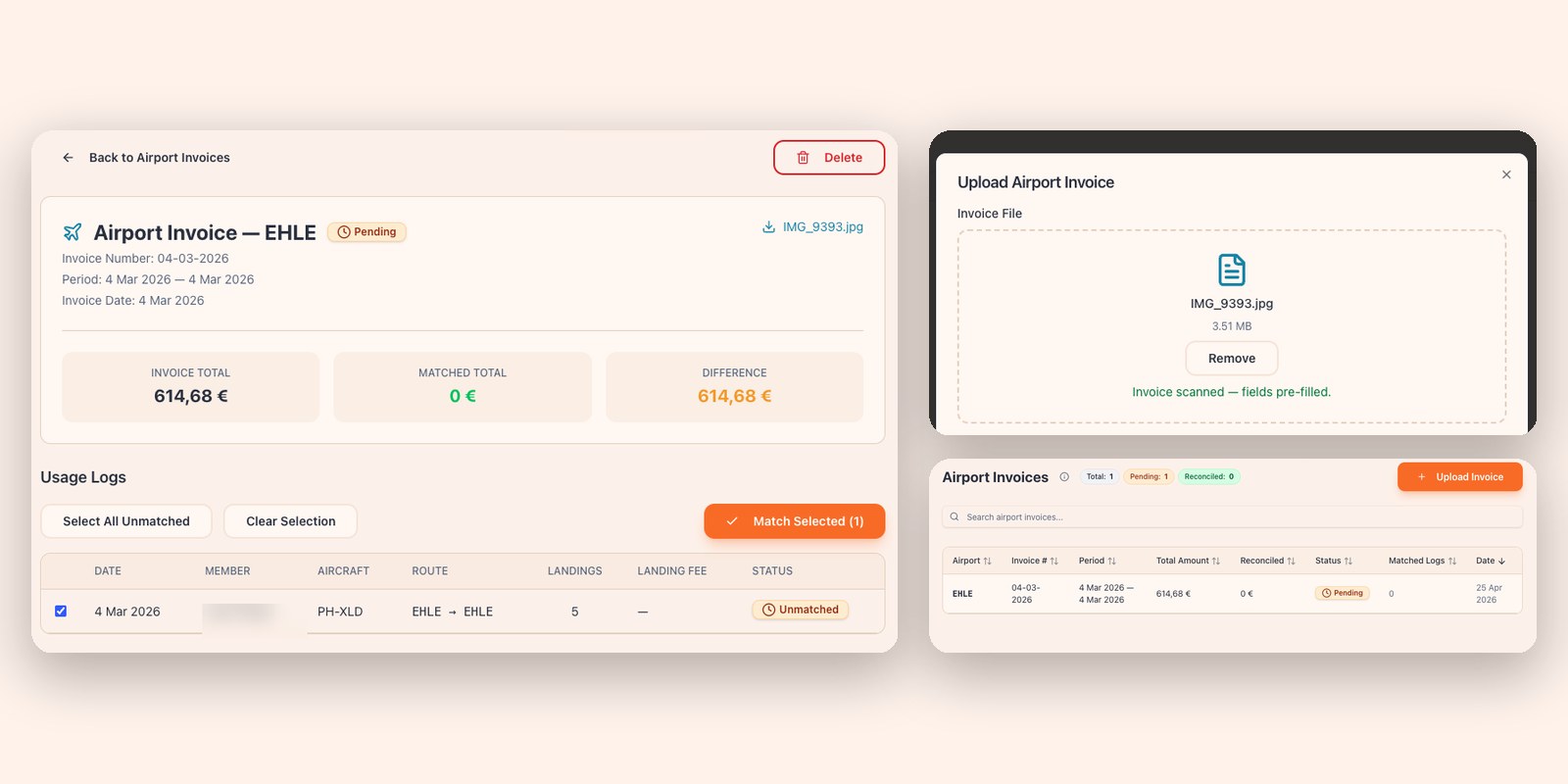
Receipts upload from a phone, get tagged as fixed or variable, and get assigned to individuals or split by the rules the group set. Usage — flight hours, miles, days — gets logged in the same place, and the platform calculates hourly or daily rates and rolls them into each member's balance in real time. Reserve funds are tracked alongside operating costs, so the group can see at a glance whether they're on schedule for the next big-ticket item. And every member sees the same picture — every expense, complete audit trail, exportable for taxes. The "where did the money go?" question stops needing to be asked.
Signs the system isn't working
There are a few patterns that almost always mean the cost-sharing setup needs revisiting. Members not knowing what they owe until somebody sends an awkward text. Receipts living in glove boxes or getting lost. One person doing all the accounting while everyone else just trusts them. No maintenance reserves, so something breaking turns into a scramble. Unequal usage paired with equal cost sharing, with nobody having brought it up. No written agreement at all on how costs split. Major purchases happening over text message without a real vote. Each one is fixable in isolation, and any two of them together usually mean the structure has drifted further than people realise.
Putting it in writing
A real cost-sharing agreement should cover five things: the fixed-cost allocation (what's included, how it splits, payment schedule, due dates and late fees), the variable-cost allocation (what's included, how the rate is calculated, how usage is tracked, how often you reconcile), the reserves (how much to maintain, what they cover, how they're replenished, who can authorise spending), the special-situations playbook (damage, improvement-versus-maintenance rules, dispute resolution, exit procedures), and the administrative scaffolding (who manages the books, how records are shared, approval thresholds for expenses, an annual review).
A short example of what that can look like in practice:
COST SHARING AGREEMENT

Fixed Costs: Split equally among all owners, paid monthly by the 1st
of each month. Fixed costs include insurance, hangar rental, annual
inspection, and registration fees.

Variable Costs: Charged per flight hour at $142/hour, which includes
fuel, oil, hourly maintenance, and engine/propeller reserves. Each
owner pays for their own flight time.

Maintenance Reserve: $25/hour included in variable rate. Reserve fund
maintained at minimum $15,000 balance. Expenditures over $5,000 require
majority owner approval.

Damage: User who caused damage beyond normal wear pays for repair.
Unknown cause splits among owners.

Payment: Due within 15 days of monthly statement. Late payments accrue
5% monthly interest.
What good looks like
The best cost-sharing systems share the same shape: fair, so every owner feels their share is genuinely their share; transparent, so every cost and payment is visible to everyone; automated enough that nobody has to be a treasurer in their spare time; documented, both in a written agreement and in a digital record; and simple enough to explain in a sentence to a new member. Get those right and money stops being the source of friction. Get them wrong and you'll spend more time arguing about finances than actually using the asset.
You can absolutely manage this manually with a spreadsheet for cost tracking, a folder for receipts, a usage log, a payment tracker and a regular reconciliation meeting. It works. It just takes a steady hand and someone willing to maintain it. The alternative is to use Kai's expense management, where the receipts, usage logs, member balances and exportable reports are part of the same system — and the spreadsheet stops being someone's part-time job.
Shared ownership is excellent when the finances are handled well. It gives you access to assets you'd struggle to afford alone, splits the burden of ownership across people who actually want to share it, and tends to build a small community around the asset itself. None of that survives a bad cost-sharing structure. Take the hour to set it up properly now — your future self, and your co-owners, will be glad you did.
Try Kai or see the features to see how it handles real numbers.